Stone, marble or tiles: the right paving for your pool
The paving around the pool must not be slippery when wet, must not burn your feet in August and must carry water away from the pool. Looks come after these three.

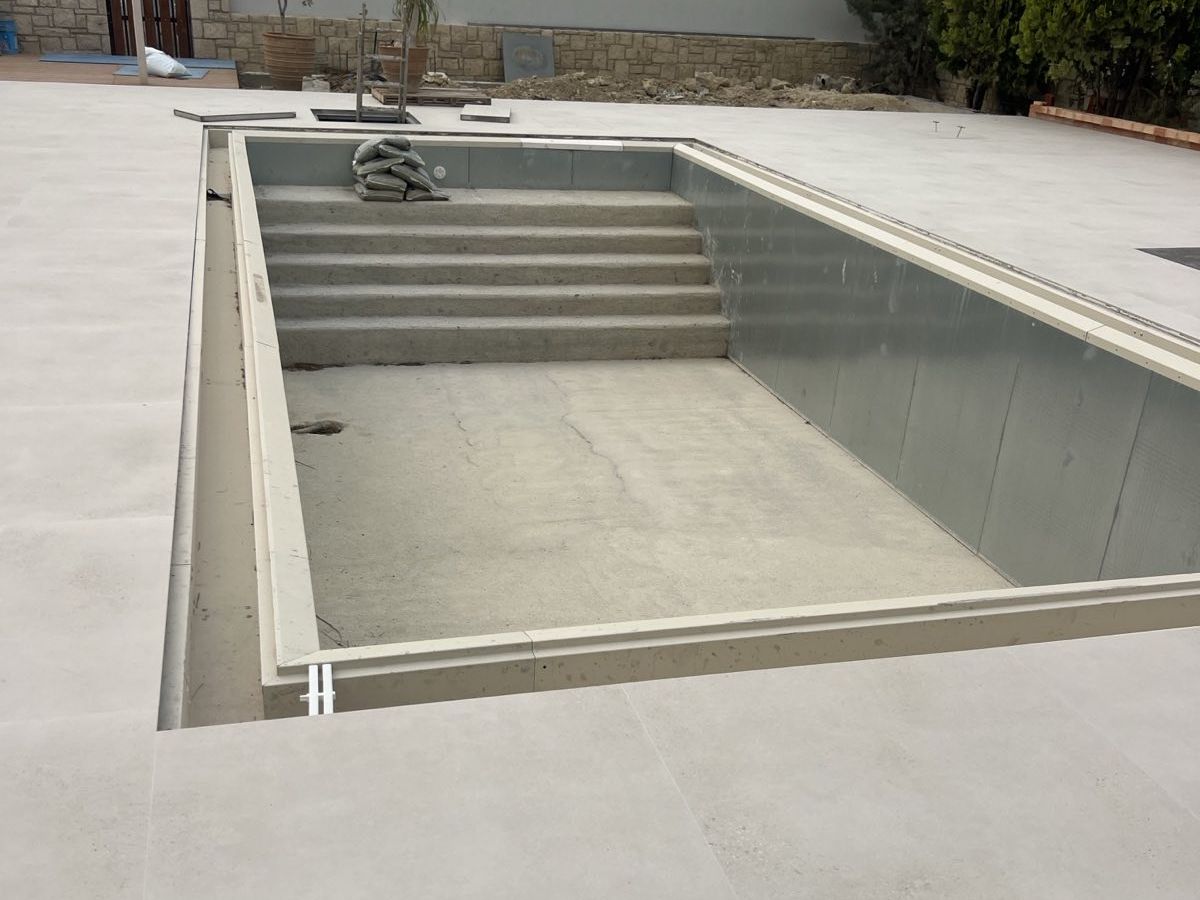

The materials compared
| Material | Slip resistance | Heat underfoot | Maintenance |
|---|---|---|---|
| Natural stone (e.g. Karystos slabs, limestone) | Good on split-face or unfinished surfaces | Light colours stay cooler, dark ones get very hot | Sealing, so it does not absorb stains |
| Marble | Only with a non-slip treatment (sandblasted, bush-hammered), never polished | White marble is one of the coolest materials | Sensitive to acids and acidic cleaners |
| Outdoor porcelain tiles | Only in a non-slip range | Depends on the colour | Easy to clean and non-absorbent |
| Wood or composite | Good with grooves | Wood stays cool, composite heats up | Depends on the material |
There is a separate guide for the pool deck. Often the best solution is a combination: stone or marble in the splash zone and wood where the sun loungers go.
Slip resistance: what to ask for
Around the pool you walk barefoot and wet, so slip resistance rated “for shoes” is not enough. For barefoot areas there is the DIN 51097 classification into classes A, B and C, with C being the most slip-resistant. Ask your supplier which class the material belongs to and which is recommended for each zone. The non-slip surface inside the pool, on steps and benches, follows the same logic.
- Avoid polished and very smooth surfaces in the splash zone.
- Very rough surfaces are less slippery, but they chafe your feet and get dirty more easily.
- The coping over the pool wall needs a rounded edge, because that is where swimmers sit and lean.
Heat underfoot
In July, dark paving in the sun can become unbearable for bare feet. Light-coloured and matt materials reflect more light and stay cooler. If you like dark shades, keep them to areas with shade or away from the water. On the other hand, brilliant white surfaces in strong sun dazzle the eyes, which is why soft beige or grey shades are often preferred. A simple test before ordering: leave samples in the sun at midday and step on them barefoot, once dry and once wet.
Slopes and drainage
Paving is never completely flat. It has a slight fall outwards, away from the pool, usually one to two centimetres per metre, so that rainwater, soil and garden fertilizers do not end up in the water. At the outer edge of the paving the water is led into a drainage channel or to an area of the garden that absorbs it. In an overflow pool, the connection between the paving and the overflow grating is designed carefully, so that water from the paving does not wash soil into the channel.
Practical tips
- Leave a comfortable walkway all around the pool and more width on the side with the sun loungers. How to divide up the space is explained in garden design with a pool.
- If you are considering salt electrolysis, ask whether the stone you choose can withstand salt water; some soft stones wear away.
- Clean with neutral cleaners, because acidic ones damage marble and limestone.
Questions
How wide should the paving around the pool be?
On the sides where you just walk, a comfortable walkway of around one metre or a little more is usually enough. On the side with the sun loungers you need enough space for people to walk in front of them without stepping on the pool edge.
Is marble paving suitable for a salt pool?
It can be done, but it needs care: marble is sensitive to acids and salt can crystallize in its pores. Sealing the material, rinsing with fresh water and advice from your stone supplier are essential.
See also
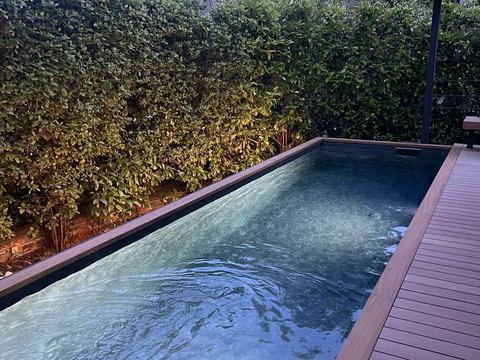


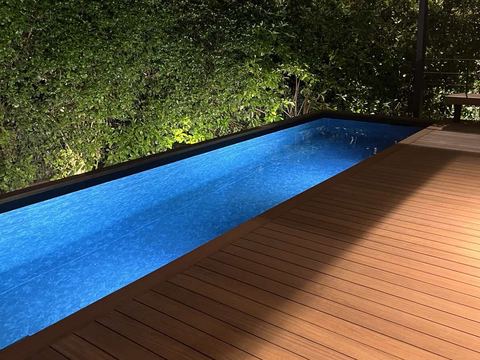
Pool deck
A pool deck in wood or composite: the differences, ventilating the substructure, maintenance, heat underfoot…
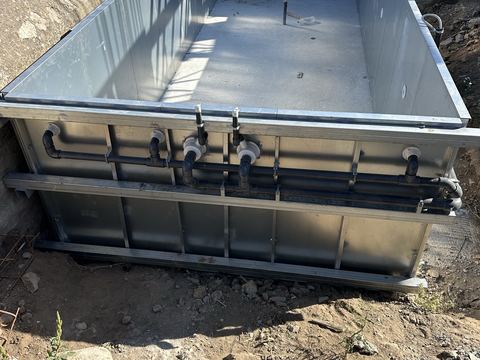


Overflow grating
Pool overflow grating in plastic or marble, about 25 cm wide: the differences, solutions for corners,…

Garden design
Garden design with a pool: how to set out zones for swimming, loungers, shade and dining, where the paths run…