Shade for you, sun for the water: how to shade the pool area
The right shade protects people on the sun loungers and at the table, while leaving the water in the sun to warm up. Pergola, umbrella or sail: each suits a different spot and a different wind.


The basic principle
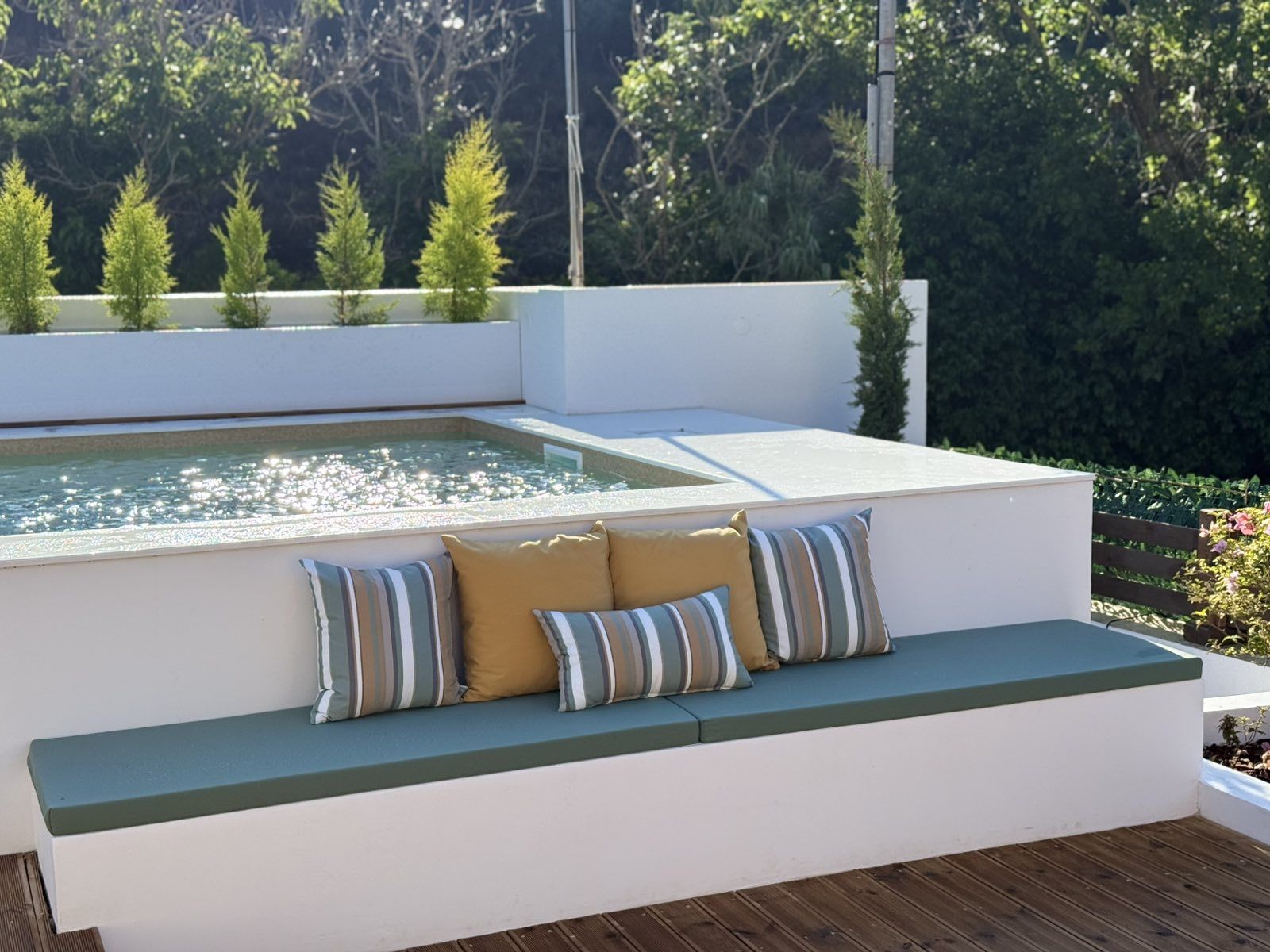
The sun is the simplest source of heat for a pool. A pool that is shaded all day stays cold and its season gets shorter, while shade from trees usually brings leaves into the water too. That is why you shade the areas where people sit, not the surface of the water. The only exception is a small section, for example around the steps, where young children play at midday. For how to make use of the sun for heating, see solar pool heating.
Before you decide, watch where the sun falls at the times you use the pool. Afternoon shade from the west is usually the most valuable. If the pool has not been built yet, the path of the sun is considered together with the position of the pool in the garden.
The options
| Solution | Strengths | What to watch for |
|---|---|---|
| Pergola with a fixed cover (reed, wood, panels) | Permanent shade, defines a space for eating or relaxing | Needs foundations and design; the cover must withstand the wind |
| Pergola with adjustable louvres | You adjust shade and light, it closes when it rains | Needs power for the motors and regular cleaning |
| Centre-pole umbrella | Simple, easy to move | The pole takes up space between the sun loungers |
| Cantilever umbrella | Shade without a pole in the middle, turns with the sun | Heavy base or a fixed anchor in the ground |
| Shade sail | Light, modern, covers large areas | Strong fixing points, correct tensioning and a fall for rainwater |
| Trees | A coolness no structure can give | Leaves and roots; plant them at a distance |
Whether a permanent pergola needs an approval or permit is something your engineer confirms before it is built.
Wind and safety
- Umbrellas are closed when not in use and always before strong wind. An open umbrella that gets blown away can end up in the pool or on a person.
- Sails come down when the wind picks up and in winter. On the islands, with the meltemi, a fixed pergola is usually more practical.
- Posts and bases go at a distance from the pool edge, so a walkway stays clear and the pool walls are not loaded.
- Any permanent structure with electricity, such as lighting or motors, is installed by an electrician, with protection from water.
Materials and details
Outdoor shade fabrics are resistant to UV radiation. Perforated fabrics let the air through and hold less heat underneath, while waterproof ones also protect from rain but catch more wind. Light colours heat up less, darker ones give denser shade.
A vine over the sun loungers is a classic image, but in August the grapes attract wasps and in autumn the leaves fall into the water. For what to plant near the pool, see plants around the pool. Under the shade, a deck makes the area more pleasant underfoot, and how to divide the garden into zones is explained in garden design with a pool.
Questions
Does the water need shade to stop it turning green?
No. The sun uses up chlorine, but with proper filtration and chemistry the water stays clean in the sun too. Preventing algae is about the right chemistry, not shade.
Can a shade sail withstand the meltemi?
Only if it is properly tensioned on sturdy fixing points, and even then it is better to take it down when the wind picks up. On exposed island plots a fixed pergola is usually the safer choice.
See also



Garden design
Garden design with a pool: how to set out zones for swimming, loungers, shade and dining, where the paths run…
Plants around the pool
Plants around the pool: which ones suit the Greek climate and which to avoid because of leaves, roots, thorns…
Pool deck
A pool deck in wood or composite: the differences, ventilating the substructure, maintenance, heat underfoot…