Why the pool smells of chlorine and your eyes sting
A strong "pool smell" rarely means too much chlorine. It usually means free chlorine is not enough and chloramines have formed, which are cleared with shock chlorination, airing and good circulation.


Where the smell comes from
When free chlorine meets sweat, urine, sunscreen and other nitrogen compounds that swimmers bring in, it combines with them and forms chloramines. These make up what is called combined chlorine: they disinfect very little, evaporate easily and have that familiar pungent smell. They also irritate the eyes, nose and skin.
A properly chlorinated pool smells of very little. The smell shows that the chlorine has started working but did not have enough quantity to finish the job.
Test before you do anything
You need to test free and total chlorine, with DPD or a photometer (see how to test properly). The difference between them is combined chlorine.
- Combined chlorine close to zero: there are no chloramines causing trouble.
- Combined chlorine above about 0.2–0.5 mg/l: the smell and irritation begin, especially if free chlorine is low.
- Free chlorine below 1 mg/l: there is not enough disinfectant for the way the pool is being used.
Red eyes: not only chloramines
| What you notice | Likely cause | What to do |
|---|---|---|
| Strong smell and stinging | Chloramines | Shock chlorination and airing |
| Red eyes without a smell | pH outside 7.2–7.6 | Correct the pH |
| Stinging right after a dose | High chlorine, locally or throughout the pool | Wait until it is back to 1–3 mg/l |
| Irritation with cloudy water | Very high pH, often with high alkalinity | Correct the alkalinity first, then the pH |
pH plays a double role: outside its range it is irritating in itself, and as it rises it makes chlorine less effective, which encourages chloramines to form.
How to clear the water
- Shock chlorination: the practical rule is to raise free chlorine to about ten times the combined chlorine, so the chloramines are broken down. The procedure, and how long to wait before getting back in, are described in shock chlorination. Alternatively, a chlorine-free shock with active oxygen oxidizes the pollution.
- Airing: leave the pool uncovered after the shock so the gases can escape. A cover kept closed all day traps chloramines right above the water.
- Filter and circulation: clean the filter and run the pump for more hours for one or two days.
- Partial water replacement: if the problem keeps coming back, replace part of the water, never all of it in a liner pool.
What does not help is covering the pool so it does not smell, or simply adding a few more tablets to the dispenser. Stabilized tablets slowly raise the stabilizer level; when it is very high, chlorine acts more slowly and chloramines persist, so the real fix is partial water replacement.
Prevention
- A quick shower before swimming removes much of the sweat and sunscreen.
- Regular toilet breaks for young children.
- Steady free chlorine every day, instead of large doses at long intervals.
- After a party or many swimmers, test the next day and shock if needed.
- In heavily used pools, a UV-C lamp in the circuit continuously breaks down chloramines; see UV disinfection.
Questions
If it smells of chlorine, why should I add more?
Because the smell comes from combined chlorine, not free chlorine. Only enough free chlorine breaks down chloramines; once they are gone, the smell disappears, even though more chlorine went in.
My eyes sting but the pool does not smell. What is wrong?
Most likely the pH. Test it and bring it to 7.2–7.6; if everything is within range, check whether chlorine was added recently and wait for the water to mix.
See also


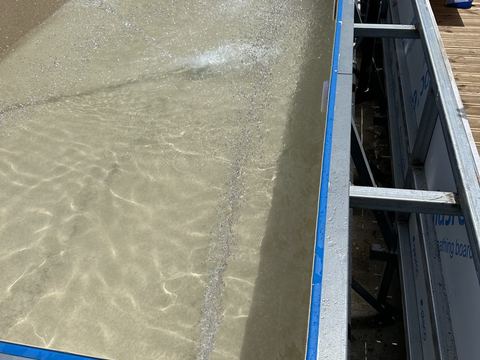

Shock chlorination
Pool shock chlorination: when you need it (storms, many swimmers, cloudy water), how to do it without harming…



UV disinfection
UV pool disinfection with a UV-C lamp in the circuit: what it does to germs and chloramines, how it is…

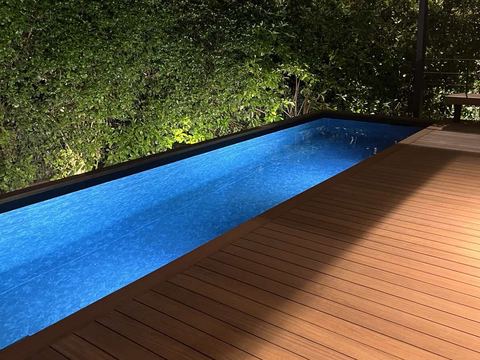

Pool shower
Pool shower: why a quick rinse before swimming keeps the water clean, solar or simple shower, where to put it…