How a prefab pool stays watertight
In a prefab pool, watertightness comes from the liner, not the walls. The most sensitive points are where the membrane is interrupted: at the fittings, the lights and the pipework.


Who does what: walls and membrane
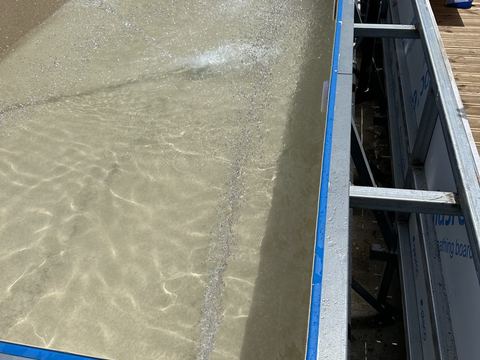
The 2 mm galvanized steel panels, the support buttresses and the anchoring carry the weight and pressure of the water. But they are not what holds the water in. That job is done by the 1.5 mm PVC membrane with internal fibre reinforcement, which lines the floor and walls as one continuous shell.
This division of roles has an important advantage. The membrane is flexible and follows small movements of the structure and the ground without cracking, while the panels don't need to be watertight. Its seams are hot-air welded so that the pieces become a single material. More on this in reinforced PVC membrane.
Watertightness is decided at installation: a smooth floor with no sharp points, a protective underlay, careful seams and properly tightened fittings. A pool that starts out right rarely needs work later. Most problems in the following years come from wear, out-of-range chemistry or mechanical damage, and those are things you can keep an eye on.
The critical points: the fittings
Wherever there is a skimmer, return inlet, light or drain, the membrane has to be opened. There, watertightness is achieved with a "sandwich": the membrane is pressed between rubber gaskets against the body of the fitting by a face plate screwed down evenly all the way round.
- If a screw loosens or a gasket ages, a small leak can appear right behind the fitting.
- Gaskets are usually replaced every time a new liner goes in.
- You can inspect these points easily with a simple mask: rust on the screws, stains, or dust being drawn toward the fitting are signs worth attention.
You'll find what each of these fittings does in pool fittings.
Pipework and plant room
Watertightness doesn't end at the membrane. Water can also be lost from the pipes between the pool and the plant room, from joints and valves, from the filter or the pump. A leak on the suction side often shows up as air in the pump strainer. A leak on the pressure side shows up as damp or sunken ground above the pipe route. Pressure testing the pipework is a job for a technician, but you can spot the signs yourself.
Checks to do every year
- Mark the water level and compare it with the expected evaporation. If in doubt, do the bucket test, explained in pool water evaporation.
- Check the screws and gaskets on skimmers, return inlets and lights.
- Look over the plant room for drips, damp and scale at the joints.
- Check the membrane on steps, in corners and along seams for abrasion or tears; small damage is fixed as described in liner repair.
- Keep the chemistry right, because a membrane that hardens loses its elasticity and cracks more easily.
If the water level drops noticeably more than heat and wind can explain, don't just top it up. Follow the steps for a pool leak or call a technician.
Questions
Do the walls need a waterproofing coat under the liner?
No. The panels don't hold water; the membrane provides the watertightness. Underneath it there is usually a protective underlay, not a waterproofing layer.
Can an earthquake affect the pool's watertightness?
The flexible membrane withstands small movements without cracking. After a strong earthquake, though, it is worth watching the water level and checking the fittings and pipework.
See also


Pool leaks
Leaks in a liner pool: warning signs, the bucket test, dye testing at gaskets and inlets, plant room pipework…


Reinforced PVC membrane
Reinforced PVC pool membrane: what the reinforcement does, how it is hot-air welded on site, and how it…


Liner repair
Pool liner repair: how to patch a small tear underwater without draining the pool, and when you need a…