The pool plant room: design that makes the difference
The plant room houses the pump, the filter, the electrical panel and any other equipment you choose. Its location, ventilation and drainage determine the noise, the maintenance and the lifespan of the equipment.


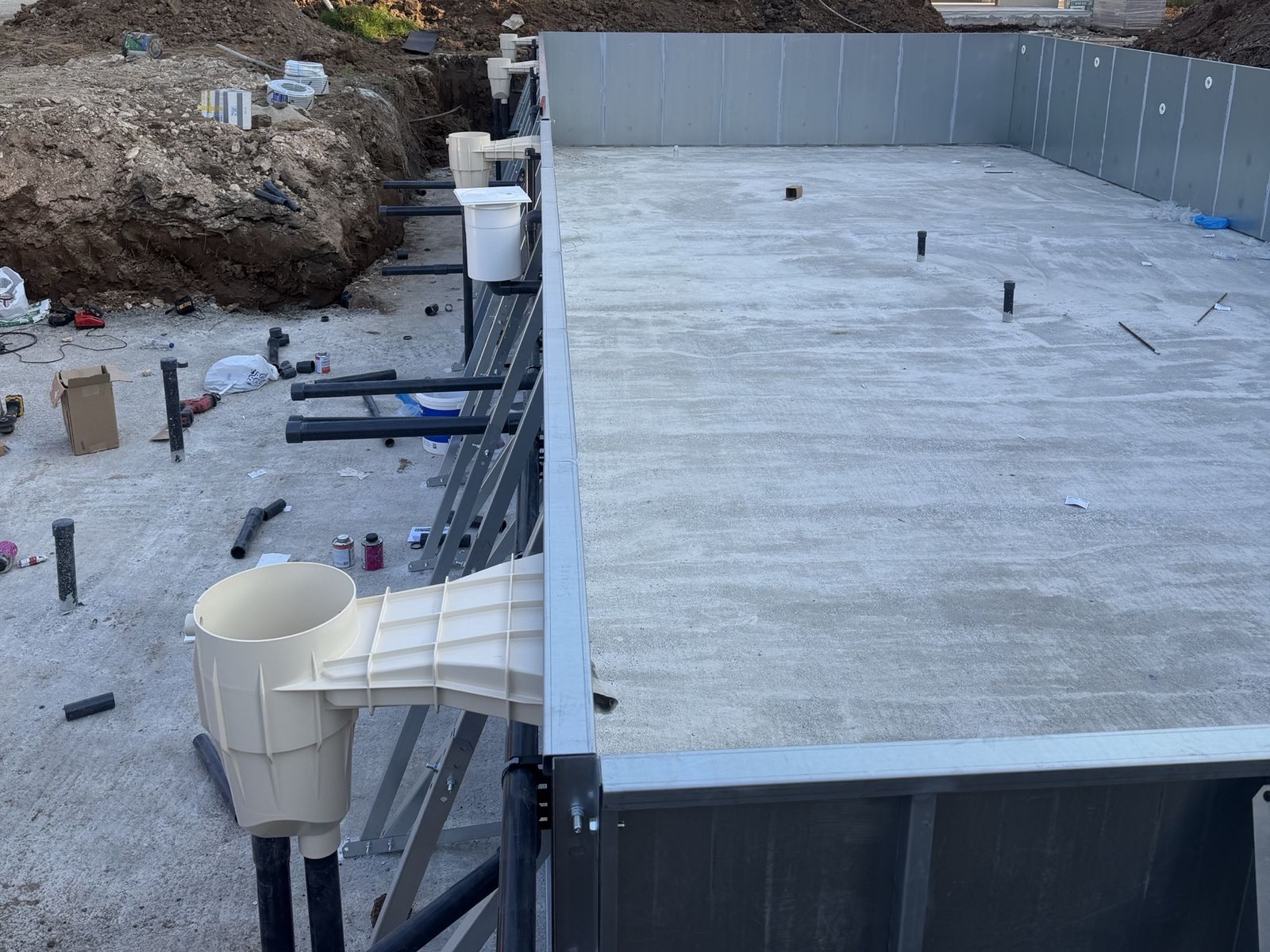
Conventional or compact
There are two main options. A conventional plant room is a small space next to the pool, about 3×2×2 m, where all the pipework ends up. A compact plant room is a self-contained unit with the core equipment and takes up much less space. Compact is also a requirement for the small-scale works approval.
| Conventional | Compact | |
|---|---|---|
| Space | About 3×2×2 m | A single unit near the pool |
| Additional equipment | Easily fits heating, UV, dosing pumps | Limited room for additions |
| Maintenance | You step inside and work standing up | Through a lid or door on the unit |
| Small-scale approval | Not eligible for the small-scale works approval | Required for the small-scale works approval |
Where to put it
- Close to the pool. Every metre of pipe and every bend adds resistance. With short runs the pump works more easily and uses less power.
- Low relative to the water. When the pump sits below the pool's water level, it fills with water by itself and starts without trouble. If it sits higher, you need a self-priming pump and completely airtight connections on the suction side.
- Away from bedrooms, yours and the neighbours'. See also the article on pools and neighbours.
- Close to power and drainage, so you do not need long runs of cable and pipe.
Below ground or above ground
An underground plant room is hidden below the paving or the deck and leaves the garden free. It is convenient because the pump sits below the water level. But it needs good protection from rainwater, reliable drainage and a lid that opens easily. An above-ground plant room is easier to access and ventilate and can be clad in wood or stone or hidden behind plants. The choice depends on the plot, the levels and the type of pool, and is made at the site survey.
Ventilation, drainage, noise
- Ventilation. The pump motor heats up, and chemical fumes corrode metal and electrics. You need ventilation openings or a small fan. Chemical stocks are best stored in a separate, ventilated space.
- Drainage. Backwash water needs somewhere to go, and a small leak must not flood the equipment. An underground space often gets a floor drain or a drainage pump with a float switch. Your engineer confirms where the backwash water is allowed to go.
- Noise. A firm base for the pump, rubber mounts, sound insulation and a variable-speed pump all help.
- Electrics. A panel with a residual current device (RCD), timer and earthing, installed by an electrician and protected from moisture.
- Frost. In mountain and northern areas the space must protect the pump and filter from freezing; otherwise they are drained completely when the pool is winterized.
Access for maintenance
A plant room you cannot get into comfortably is a plant room that never gets checked. Leave room around the filter for changing the sand, light to read the pressure gauge and a shelf for the test reagents. The heat pump, if there is one, stays outside in an open spot. You will find the core equipment on the pool equipment page.
Questions
How far from the pool can the plant room be?
The closer the better, usually within a few metres. A greater distance means more losses in the pipework and possibly a bigger pump; the final position is decided at the site survey.
Can the heat pump go inside the plant room?
Usually not. A heat pump takes heat from the air, so it needs an open space with free airflow. It goes outside, near the plant room, and is connected to the circuit after the filter.
See also


Pool equipment
Essential pool equipment: a 3 × 2 × 2 m plant room or a compact unit, pumps and filters. How to choose the…


Pool pump
Pool pumps: flow rate and head, pre-filter, single-phase or three-phase, self-priming and noise. What to…

Small-scale works approval
The small-scale works approval for a pool step by step: what the engineer checks, which documents are usually…